Why Copper Paste Shrinks During Via Filling
Copper paste is widely used for via filling in HDI PCBs, TGV substrates, multilayer circuits and advanced electronic packaging. However, one common manufacturing problem is that a via appears completely filled before curing, but becomes recessed, develops voids or loses volume after curing.
Why does this happen? In most cases, copper paste shrinkage is related to solvent evaporation, organic binder changes, copper particle packing, trapped air and an unsuitable curing process. Understanding these mechanisms can help manufacturers achieve more stable and reliable via filling.
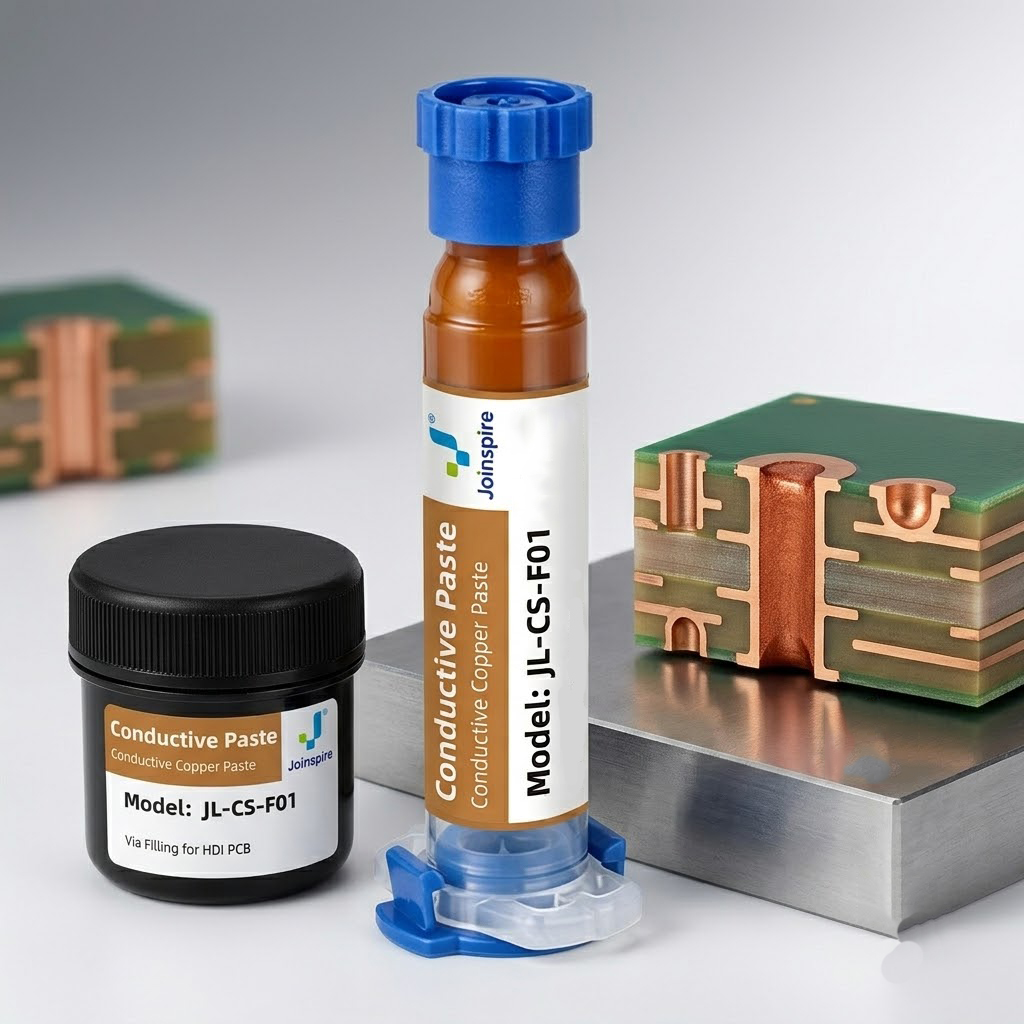
Copper paste usually shrinks during via filling because volatile materials leave the paste during drying or curing, while the remaining copper particles and binder reorganize into a denser structure. If the volume loss is too high or the process is poorly controlled, the result can be dishing, internal voids, incomplete filling and unstable electrical performance.
1. Solvent Evaporation Is a Major Cause of Copper Paste Shrinkage
Conventional conductive copper pastes normally contain copper particles together with solvents, binders and other organic components.
Before curing, these components occupy part of the total paste volume. During drying and thermal curing, volatile solvents gradually evaporate. The material remaining inside the via therefore occupies less volume than the original wet paste.
This is one reason a via that looks completely filled immediately after printing may become lower than the surrounding surface after curing. This recessed surface is commonly described as dishing.
2. The Binder Changes During Curing
Copper paste is not simply loose copper powder. A binder system holds the particles together before and during processing.
As temperature increases, the binder may polymerize, decompose, crosslink or otherwise change its structure depending on the paste formulation. These changes can cause dimensional changes inside the filled via.
Some controlled shrinkage is not automatically a defect. In conductive materials, moderate densification can bring conductive particles into closer contact and help form a continuous conductive network. The real problem is excessive or uneven shrinkage.
3. Copper Particle Packing Affects Final Volume
The size, shape and distribution of copper particles strongly affect how densely the paste can fill a microvia.
If the particles are poorly distributed, large spaces can remain between them. During curing or sintering, the particles move closer together and the structure becomes denser, resulting in measurable dimensional change.
A carefully designed particle-size distribution can allow smaller particles to occupy spaces between larger particles, helping improve packing density while maintaining suitable paste rheology.
4. Trapped Air Can Be Mistaken for Shrinkage
Not every recessed or incomplete via is caused purely by chemical shrinkage.
Air can become trapped inside deep or high-aspect-ratio vias during printing, dispensing or squeegee filling. After heating, the trapped gas can expand or migrate, leaving internal voids.
From the surface, the defect may look similar to material shrinkage, but the root cause is incomplete filling.
5. An Incorrect Curing Profile Can Make Shrinkage Worse
Heating the paste too quickly may cause volatile components to escape before the material can stabilize. This can increase the risk of bubbles, internal voids or surface collapse.
On the other hand, insufficient curing may leave the conductive network incomplete and lead to unstable resistance or weak mechanical properties.
The recommended curing temperature, heating rate and holding time should therefore be matched to the specific copper paste formulation and substrate.
What Problems Can Excessive Via Filling Shrinkage Cause?
| Problem | Possible Cause | Potential Impact |
|---|---|---|
| Dishing | Excessive volume loss | Uneven via surface |
| Internal Voids | Trapped air or rapid solvent release | Higher resistance and reduced reliability |
| Cracking | Uneven curing or excessive stress | Electrical or mechanical failure |
| Poor Adhesion | Interface stress or contamination | Delamination risk |
| Resistance Variation | Non-uniform conductive network | Inconsistent electrical performance |
How to Reduce Copper Paste Shrinkage During Via Filling
Use a High-Solid or 100% Solid Formulation
Reducing volatile solvent content is one of the most direct ways to reduce volume loss during curing. A high-solid formulation leaves more functional material inside the via after processing.
Optimize Paste Rheology
The paste must be fluid enough to penetrate the via while maintaining sufficient stability to prevent particle sedimentation or material flow-out. Suitable thixotropy and viscosity are especially important for fine and high-aspect-ratio vias.
Remove Trapped Air
Degassing the paste and using vacuum-assisted processing can reduce the possibility of internal air pockets.
Consider Multi-Step Filling
For deep vias, one-pass filling may not always provide sufficient filling density. A controlled fill, dry and refill process can compensate for volume changes and improve final via geometry.
Follow the Recommended Cure Profile
Temperature should be increased according to the material's recommended process window rather than simply applying the highest possible temperature. Controlled curing helps organic components evolve more gradually while supporting the formation of a stable conductive network.
JL-CS-F01 Via Filling Conductive Copper Paste
Jufeng JL-CS-F01 is designed for conductive via filling applications where dimensional stability, electrical conductivity and thermal management are important.
Typical applications include: HDI PCBs, TGV, LTCC, 5G RF devices, thermal vias and power electronics.
View JL-CS-F01 Copper PasteWhat Should You Check When Choosing a Via Filling Copper Paste?
Instead of looking only at initial conductivity, engineers should evaluate the complete filling process.
- Solid content and expected curing shrinkage
- Viscosity and thixotropic behavior
- Copper particle size and distribution
- Compatibility with via diameter and aspect ratio
- Curing temperature and process time
- Electrical resistivity after curing
- Thermal conductivity
- Adhesion to the substrate
- Performance after thermal cycling and aging
Frequently Asked Questions
Why does copper paste sink after curing?
The most common causes are solvent evaporation, binder changes and densification of the copper particle network. Trapped air or incomplete initial filling can also create a similar recessed appearance.
Can copper paste completely fill microvias?
Yes. Conductive copper paste can be used for microvia and through-via filling, but the result depends on paste rheology, via geometry, filling method, degassing and curing conditions.
Does higher solid content reduce shrinkage?
Generally, reducing volatile components can reduce volume loss caused by evaporation. However, particle packing, binder chemistry and curing conditions must also be considered.
Is copper paste suitable for TGV filling?
Copper paste is increasingly considered for TGV metallization because it can fill dense via arrays and high-aspect-ratio structures without relying entirely on conventional electroplating processes.
Final Thoughts
Copper paste shrinkage during via filling is not caused by one single factor. It is the combined result of paste formulation, volatile content, binder behavior, particle packing, trapped air, via geometry and the curing process.
For HDI, TGV and advanced packaging applications, controlling these variables is essential for achieving dense filling, low resistance and long-term reliability.
Choosing a copper paste specifically designed for via filling can significantly simplify process optimization and reduce defects such as dishing and internal voids.
Testing a Copper Paste for Your Via Structure?
Send us your via diameter, depth, substrate and curing requirements. Jufeng can provide technical data, TDS and sample support for evaluation.
Request TDS & Sample:marketing002@jufengxi.com
How to Reduce Voids in HDI Via Filling
Related Article
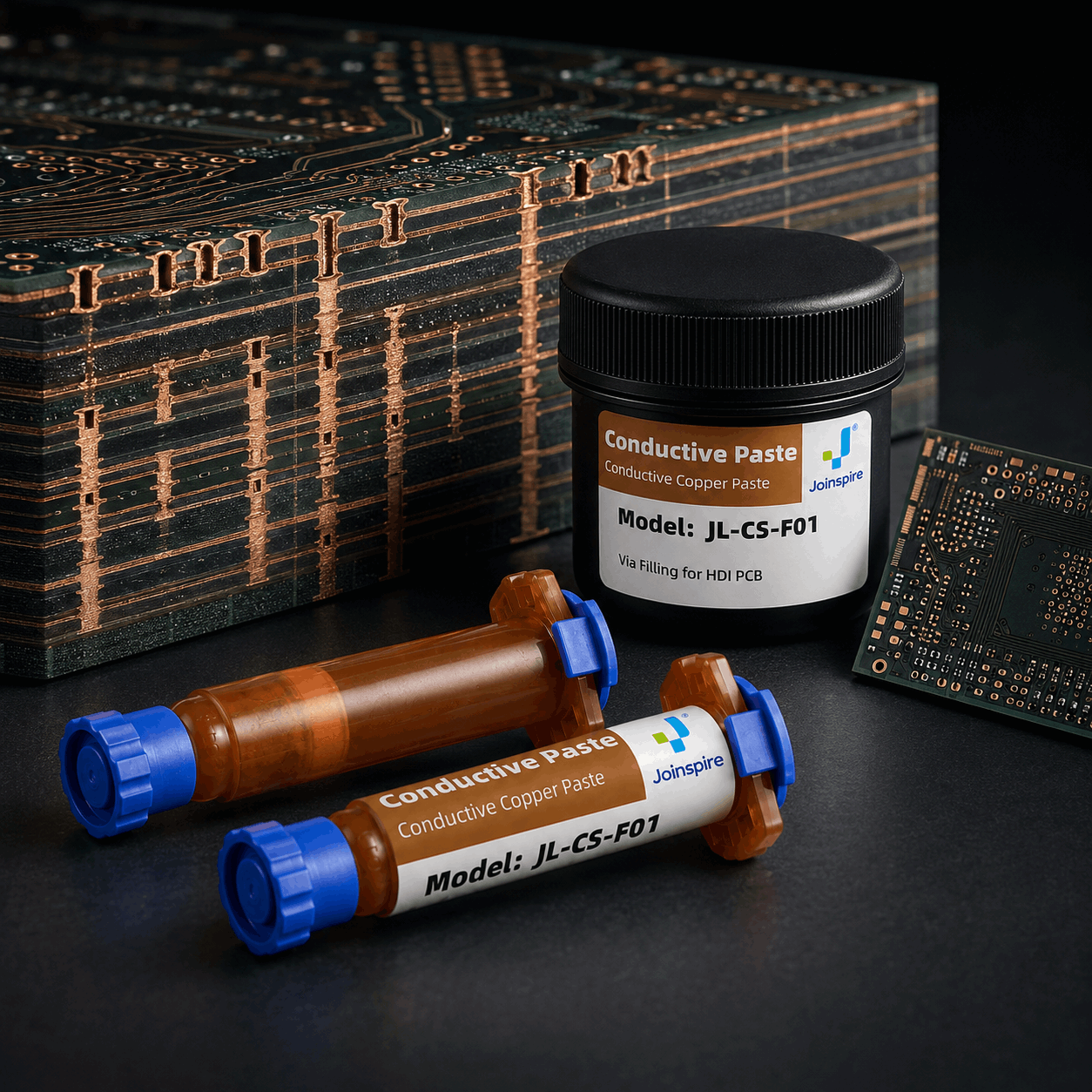

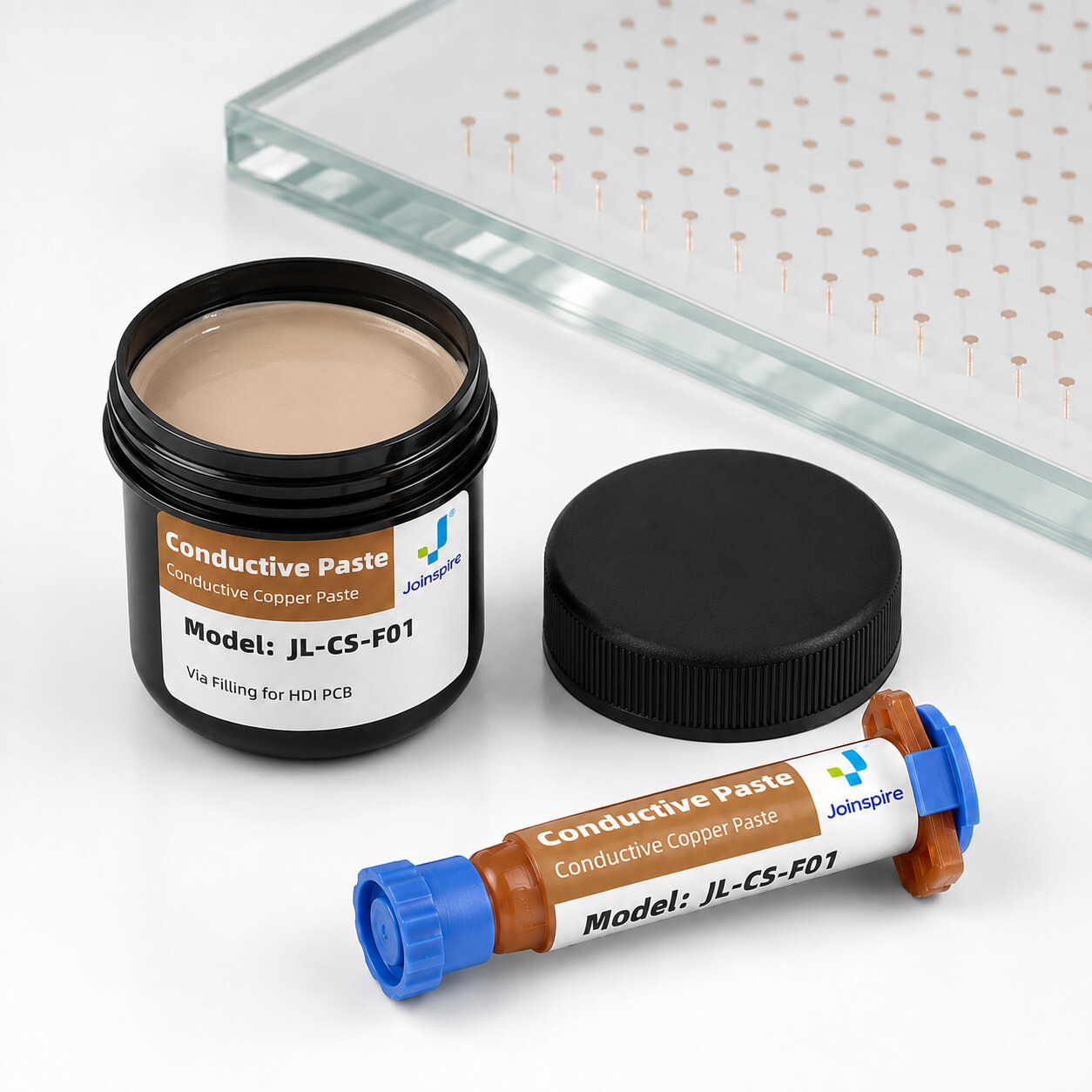
Jufeng JL-CS-F01 copper via filling paste is a single-component conductive resin material developed for via plugging and filling.