Flexible Conductive Copper Paste for Reliable Flexible Electronics
As flexible circuits, printed sensors and lightweight electronic devices continue to develop, engineers face a common material challenge: how to achieve reliable conductivity without sacrificing flexibility or manufacturing efficiency.
Jufeng JL-CS01-FE Flexible Conductive Copper Paste is a one-component, fast-curing conductive material developed for flexible electronic applications. It combines high electrical conductivity, excellent flexibility, good bending resistance and practical printing performance.

What Challenges Do Flexible Conductive Circuits Face?
Conductive materials used in flexible electronics must solve several problems at the same time. Focusing only on conductivity can lead to difficulties during printing, curing, bending or final device operation.
Conductive Layers Need Flexibility
Flexible electronic devices may bend during manufacturing, assembly or final use. Conductive patterns therefore need both electrical performance and sufficient flexibility.
Long Curing Time Reduces Efficiency
Long curing processes can slow down production. For printed electronics, fast curing can help improve manufacturing efficiency and simplify process integration.
Different Substrates Require Compatibility
Flexible and printed electronics may use PET, PI, ceramic or metal surfaces. A conductive paste that supports different substrate types can make material evaluation and process development easier.
Conductivity Alone Is Not Enough
Conductive paste also needs suitable viscosity, printability and process stability so that conductive patterns can be formed consistently during manufacturing.
How JL-CS01-FE Helps Solve These Problems
JL-CS01-FE was developed specifically for flexible electronic applications. Its combination of conductivity, flexibility, fast curing and printing compatibility helps manufacturers address several process and performance requirements with one conductive material.
Designed for Flexible and Bendable Electronics
One of the main challenges in flexible electronics is maintaining conductive performance while the substrate is bent or flexed.
JL-CS01-FE combines electrical conductivity with good bending resistance, making it suitable for applications where conductive patterns are printed onto flexible or thin substrates.

Fast 160°C Curing for More Efficient Processing
Production efficiency is another important factor when selecting conductive materials. JL-CS01-FE has a typical curing condition of 160°C for 2 minutes.
The material can be cured in an oven under either air or nitrogen. Actual curing time can be adjusted depending on printed pattern size and process requirements.
Conductivity and Printability in One Material
JL-CS01-FE provides a typical volume resistivity of 1.5 × 10⁻⁴ Ω·cm. Its solid content is above 80%, while the typical viscosity is 25±5 Pa·s.
These properties provide a practical foundation for printed conductive patterns used in flexible circuits, sensors and other electronic manufacturing processes.
JL-CS01-FE Technical Specifications
| Product | JL-CS01-FE Flexible Conductive Copper Paste |
| Appearance | Brown-gray paste |
| Viscosity | 25±5 Pa·s, viscometer @20 rpm |
| Solid Content | >80% |
| Typical Curing Condition | 160°C / 2 min, air or nitrogen, oven |
| Volume Resistivity | 1.5 × 10⁻⁴ Ω·cm |
| Applicable Surfaces | PET / PI / Ceramic / Metal |
| Printing Process | Screen printing / stencil printing |
| Recommended Screen | 100–300 mesh |
| Storage Temperature | -10°C to 10°C |
| Shelf Life | 3 months |
Applications of JL-CS01-FE Flexible Conductive Copper Paste
JL-CS01-FE is designed for flexible electronic manufacturing and printed conductive structures across several application areas.
Conductive structures that require a combination of electrical conductivity and flexibility.
Flexible pressure-touch components and related printed conductive structures.
Screen-printed or stencil-printed conductive circuit patterns on compatible substrates.
Printed conductive structures for flexible sensors and other precision electronic manufacturing processes.
Recommended Processing Guide
Storage: Store JL-CS01-FE at -10°C to 10°C and avoid high-humidity storage conditions.
Return to Room Temperature: After removing the product from cold storage, allow it to stand at approximately 25°C for about 4 hours until fully thawed. Remove moisture from the outside of the container before use.
Mixing: Centrifugal mixing for approximately 3–5 minutes before use is recommended for better processing performance.
Printing: JL-CS01-FE can be applied by stencil or screen printing. A screen range of 100–300 mesh is recommended.
Curing: Place the printed sample in an oven and heat it from room temperature to 160°C. Maintain the temperature for approximately 2 minutes. The curing time can be extended according to the size of the printed pattern.
Why Sample Testing Matters
Conductive paste performance depends on multiple factors, including substrate material, printing thickness, circuit design, screen or stencil parameters and curing conditions.
For this reason, Jufeng recommends testing JL-CS01-FE under your actual production conditions before mass production. This helps engineers evaluate printing quality, curing behavior, conductivity and compatibility with the target substrate.

Looking for a Conductive Copper Paste for Your Flexible Electronics Project?
Every flexible electronics project has different substrate, printing and conductivity requirements. Instead of selecting conductive materials only from datasheet values, project-specific evaluation can help reduce development risk.
Tell our team your substrate type, printing process, curing requirements and target application. We can provide technical information and samples for evaluation.
Evaluate JL-CS01-FE for Your Application
Contact Jufeng to obtain the JL-CS01-FE technical data sheet, discuss your application requirements and request free samples for testing.
View JL-CS01-FE Request TDS & Free Sample
Copper Via Filling Paste for TGV and HDI: JL-CS-F01
Related Article
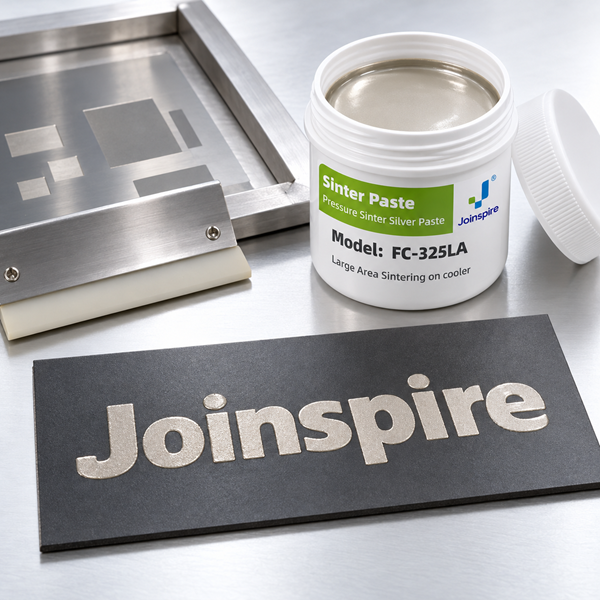
Jufeng JL-CS-F01 copper via filling paste is a single-component conductive resin material developed for via plugging and filling.
Why does SAC305 keep showing up as the default recommendation?