
Large-Area Silver Sintering: From Stable Printing to Thermal Performance
Selecting a silver sintering paste for a large bonding area involves more than comparing a single conductivity value. The material also needs to suit the printing run, attachment method, surface finish and available sintering equipment.
Joinspire FC-325LA is designed for pressure-assisted large-area silver sintering. It offers stable printing performance and supports both dry and semi-wet attachment. After sintering, the silver layer is described in the technical data sheet as uniform and dense, supporting high thermal conductivity and reliable bonding for high-power devices.
Start with a printing window that fits the process
FC-325LA is formulated to maintain operational stability during extended printing. Its TDS lists a working time of 8 hours at 19–25°C. This is a defined working condition, not a storage-life specification or a guarantee for every production environment.
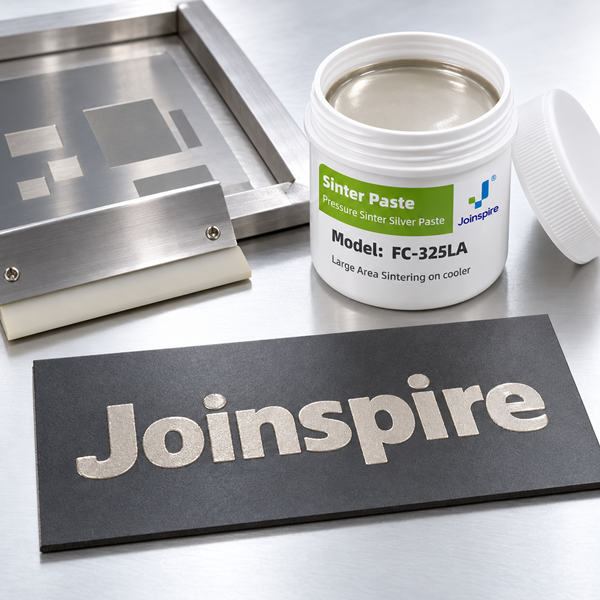
Printing concept featuring a silver-paste pattern. This image illustrates the application; it is not a print-resolution test.
Check the print and the next assembly step together
The TDS gives a viscosity of 7 ± 2 Pa·s at 20 rpm and a solids content of 80 ± 5%. Use these values when screening the material, then evaluate the deposited layer on your actual substrate.
FC-325LA supports dry or semi-wet attachment. Select the attachment route alongside the printing and pre-drying conditions, rather than treating each step as an independent setting.
Evaluate the sintered layer, then the bonded assembly
The material data below provide a starting point for selection. They do not replace evaluation of the finished assembly, its bond area, layer thickness and interfaces.
| Property | TDS value | Condition / method |
|---|---|---|
| Thermal conductivity | >200 W/m·K | Sintered layer; laser flash method |
| Electrical resistivity | <6 μΩ·cm | Material value stated in the TDS |
| Viscosity | 7 ± 2 Pa·s | Viscometer at 20 rpm |
| Solids content | 80 ± 5% | TGA |
| Coefficient of thermal expansion | 14 ppm/°C | TMA |
| Working time | 8 hours | At 19–25°C |
High thermal and electrical conductivity are material characteristics. Confirm the performance and reliability requirements of your own bonded structure through application-specific qualification.
Link printing, pre-drying, attachment and pressure sintering
FC-325LA is intended for pressure-assisted sintering. The TDS provides a recommended large-area process sequence and notes that settings normally require adjustment for the application, material and dimensions.
| Stage | Selected recommendations from the TDS |
|---|---|
| Stencil printing | Stencil thickness: 120–450 μm. Stencil gap: 0.7 mm. |
| Pre-drying | Ramp to 80°C over 20 minutes, hold at 80°C for 35 minutes, then cool to 25°C over 10 minutes. Increased layer thickness may require a longer pre-drying cycle. |
| Attachment | Dry and semi-wet attachment are supported. Room-temperature attachment is possible; the TDS recommends attachment under heated conditions. |
| Pressure sintering | 180–220°C, 10–15 MPa, with a recommended time of 5 minutes. Lower temperature or pressure may require a longer sintering time. |
This is a process overview, not a complete equipment recipe. Use the full TDS and agree application-specific parameters with the technical team before qualification.
The surface finish determines the atmosphere
The TDS lists air for gold- or silver-plated surfaces and nitrogen for bare copper during pre-drying and sintering. For pure copper substrates, nitrogen protection is required; confirm the detailed process with technical support.
Match the paste to the actual bonding surface
FC-325LA is positioned for high-power device bonding and large-area sintering on cooling structures. Its listed interface materials are silver, gold and copper. When discussing a cooling-baseplate assembly, identify the finish at the bonding surface, not only the bulk material of the plate.
Define the sample before the trial
A useful application brief includes the substrate and metallization, bonding dimensions, intended layer thickness, printing method and available sintering equipment.
These details help the technical team assess whether the recommended starting conditions suit the proposed assembly and which adjustments should be evaluated.
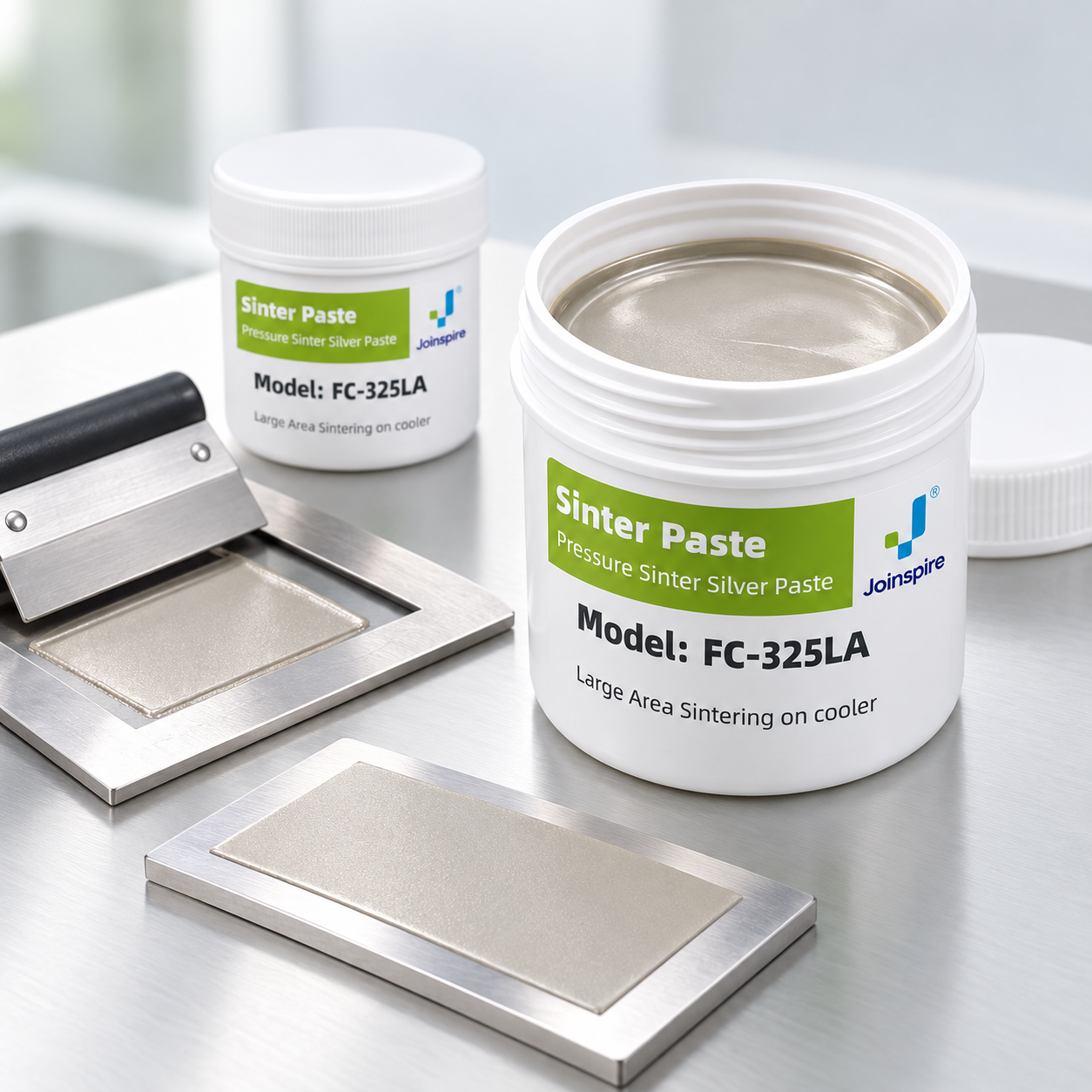
Large-area coating concept with FC-325LA and stencil-printing tools.
Include storage and preparation in the plan
Storage
The TDS lists frozen storage at −20 to 0°C or refrigerated storage at 0–10°C, with a shelf life of 6 months. Avoid direct sunlight and high humidity.
Preparation before use
Allow approximately 5 hours at 25°C for the material to return to room temperature and wipe away moisture on the container. Follow the TDS for vacuum degassing and mixing before use.
FC-325LA: frequently asked questions
Is FC-325LA a pressureless silver sintering paste?
No. FC-325LA is designed for pressure-assisted large-area sintering. Its TDS recommends a sintering pressure of 10–15 MPa, with the final process adapted to the application.
Can FC-325LA be used with bare copper?
Copper is a listed interface material. Bare copper requires nitrogen protection during the recommended pre-drying and sintering steps. Contact technical support to confirm conditions for the specific copper surface and assembly.
Does the 8-hour working time replace the storage specification?
No. The 8-hour working time applies at 19–25°C. Storage temperatures and the stated 6-month shelf life are separate specifications.
Are the recommended sintering settings suitable for every bond area?
No. The TDS states that large-area sintering generally requires customized parameters. Substrate material, dimensions, layer thickness and the available equipment should be considered during process qualification.
Discuss Your Large-Area Sintering Application
Send us your substrate finish, bonding dimensions, target layer thickness and available sintering conditions. Ask for the FC-325LA TDS and sample evaluation support.
Request TDS & SampleTechnical source: Joinspire FC-325LA Technical Data Sheet. Confirm the current revision and application-specific process with the technical team. Product and application images are AI-generated illustrations, not process-validation or test images.
Why Copper Paste Shrinks During Via Filling
Related Article
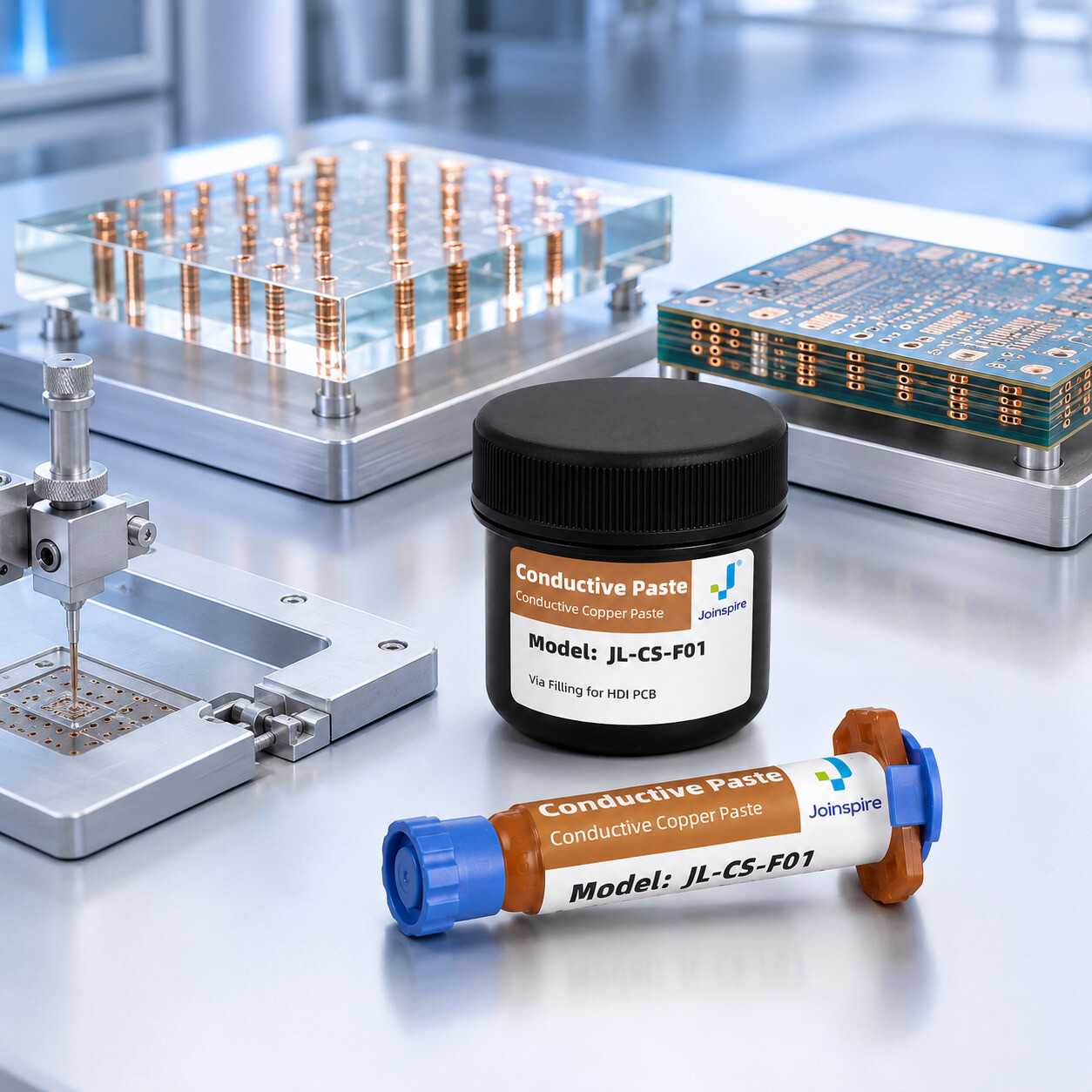
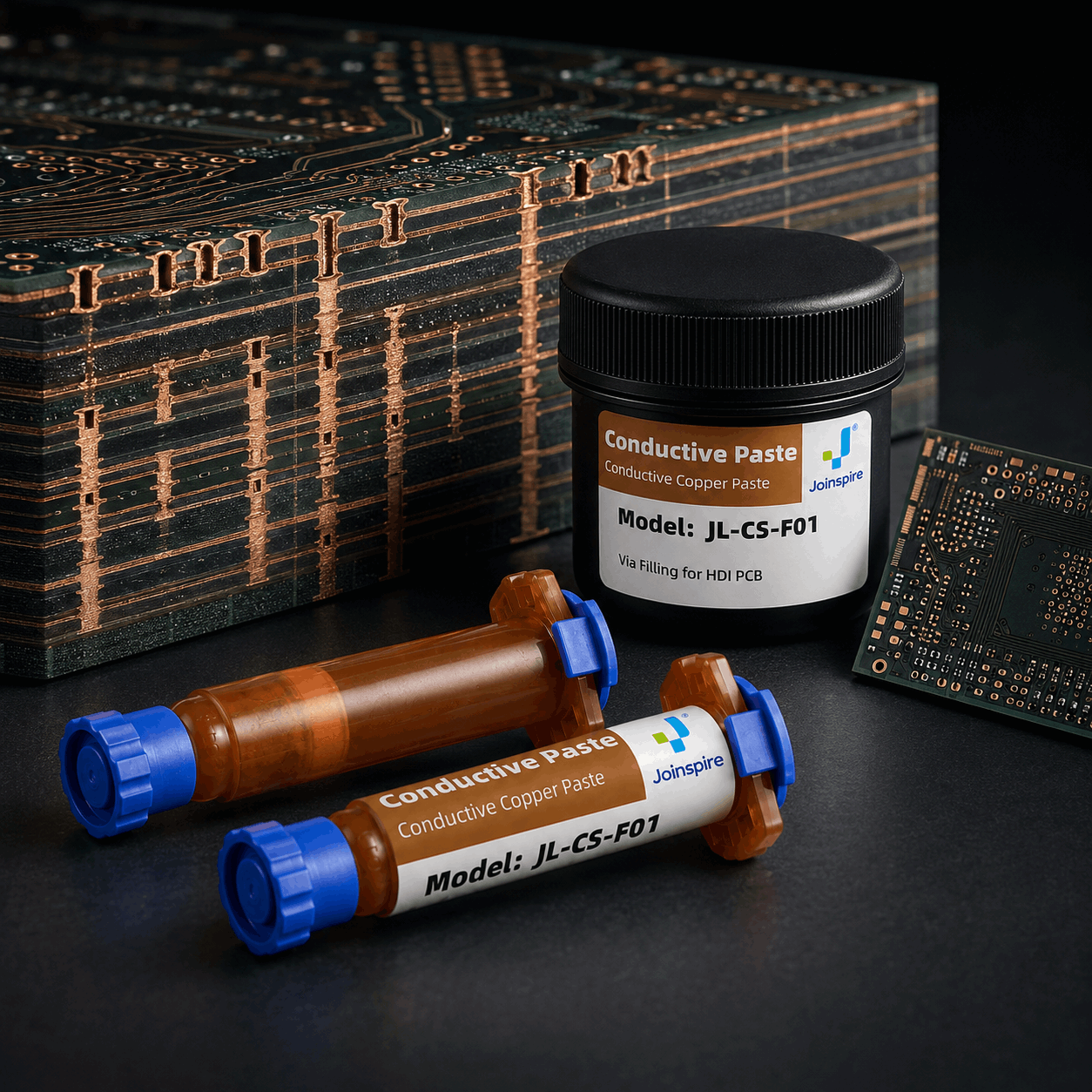

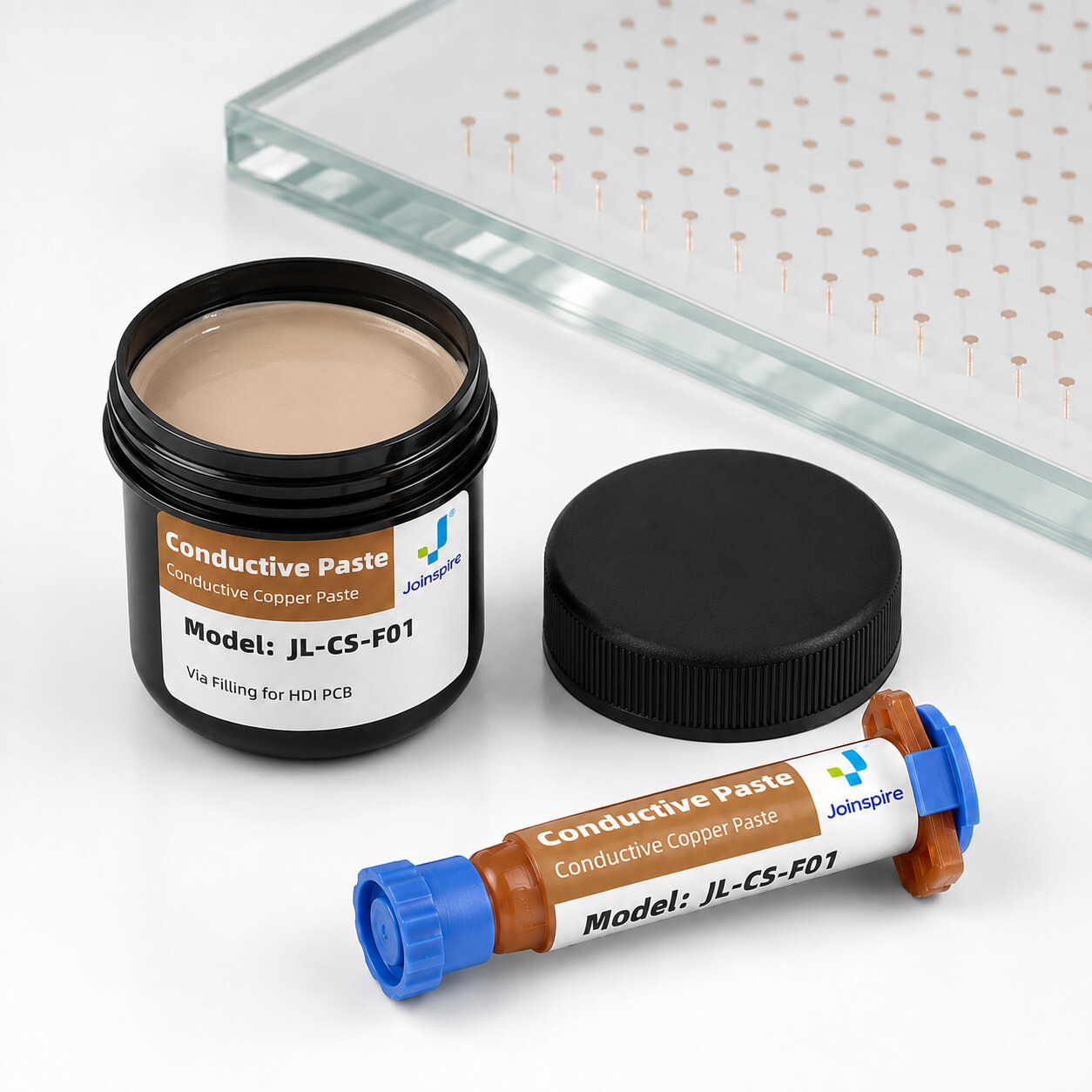
Jufeng JL-CS-F01 copper via filling paste is a single-component conductive resin material developed for via plugging and filling.
